



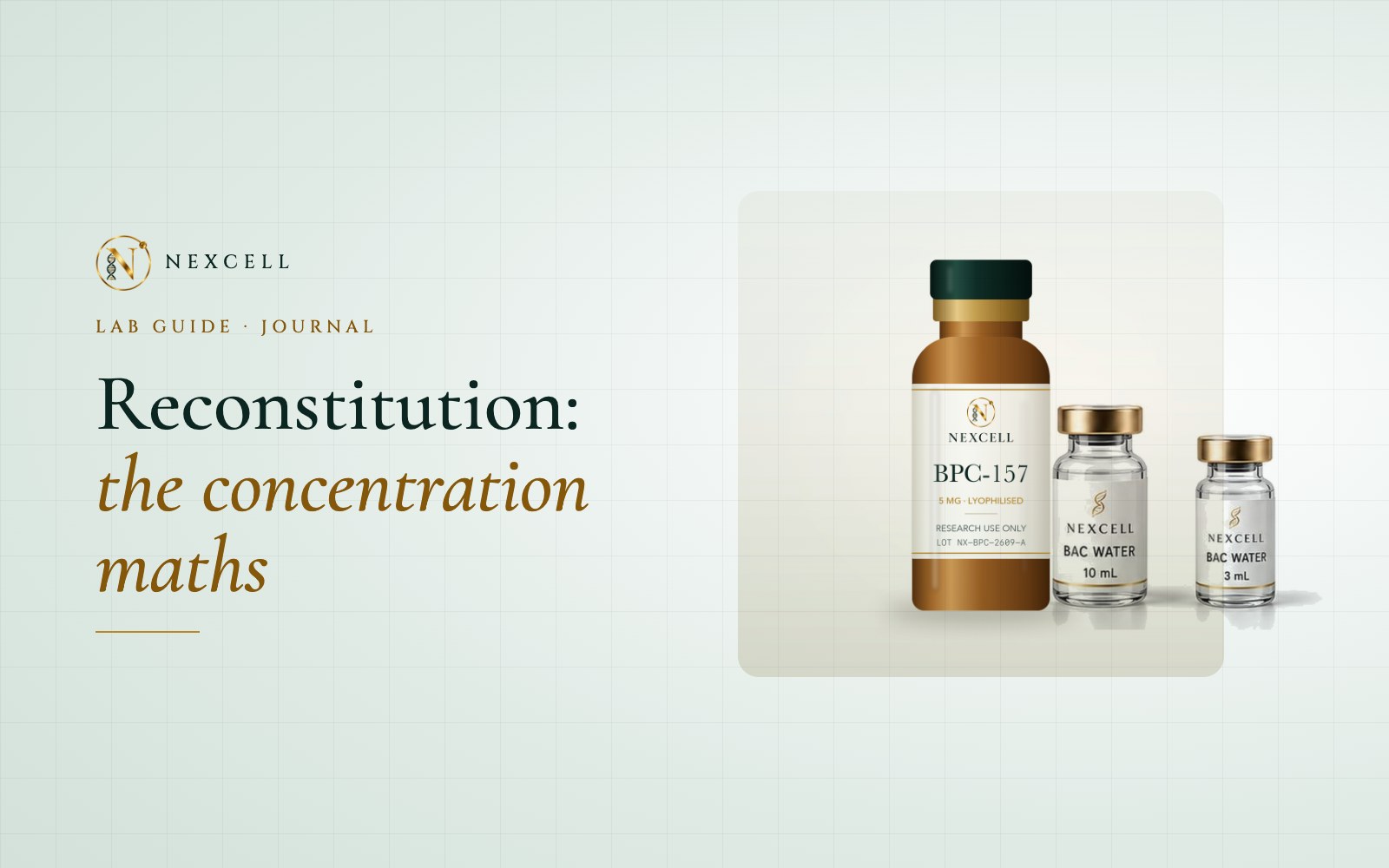
Lyophilised (freeze-dried) peptides arrive as a dry powder. Before they can be used in an assay they are usually reconstituted: a measured volume of liquid, such as bacteriostatic water, is added to the vial. The maths is simple, but it is worth writing down so every person in the lab does it the same way.
The two formulas
Concentration (mg/mL) = amount in the vial (mg) ÷ volume added (mL)
Volume containing a target amount (mL) = target amount (mg) ÷ concentration (mg/mL)
A worked example
A vial contains 10 mg of peptide and you add 2 mL of liquid.
- Concentration = 10 mg ÷ 2 mL = 5 mg/mL
- If your protocol needs 0.25 mg, the volume that contains it is 0.25 ÷ 5 = 0.05 mL (50 µL).
Adding more liquid lowers the concentration and makes small amounts easier to measure accurately; adding less raises it. Choose the volume that suits the precision of your pipettes and the stability data for your compound.
| Amount in vial | Liquid added | Concentration |
|---|---|---|
| 5 mg | 1 mL | 5 mg/mL |
| 5 mg | 2 mL | 2.5 mg/mL |
| 10 mg | 2 mL | 5 mg/mL |
| 10 mg | 5 mL | 2 mg/mL |
Good handling practice
- Let the vial reach room temperature before opening, so moisture doesn’t condense on the powder.
- Add the liquid slowly down the side of the vial and swirl gently. Don’t shake.
- Label the vial with the date, the volume added and the resulting concentration.
- Follow the storage conditions on the product page and in your lab’s SOPs, and record the batch number with your results.
Rather not do it by hand? Our free reconstitution calculator does the concentration and volume maths for you. Like this guide, it covers maths only and does not recommend how any product should be used.
For research purposes only. NEXCELL products are not medicines and are not intended for human consumption, diagnosis, treatment, cure or prevention of disease.